A Massachusetts state lawmaker, forced to retire early from the Air Force Reserve after deciding against the COVID-19 vaccine, is behind a push to preserve bodily autonomy and ban employers from coercing their employees with mandates.
State Rep. Justin Thurber and Sen. Patrick O’Connor are teaming up on legislation they say affirms that individuals have the fundamental right to make their own health decisions without government influence.
Thurber has said he wanted to serve 33 years in the Air Force Reserve, but the vaccine mandate during the pandemic robbed him of achieving that goal. He retired as a chief master sergeant in his 29th year of service.
The first-term Republican from the South Coast is sharing his story as he advocates to prohibit employers from requiring health-related interventions, such as vaccinations, mask-wearing, or genetic procedures, as a condition for employment.
“One idea I could never get out of my head was that for 29 years, I upheld my oath of enlistment and fought to defend Americans for the freedoms we enjoy, only to see those freedoms eroded,” Thurber said during a legislative hearing last Tuesday.
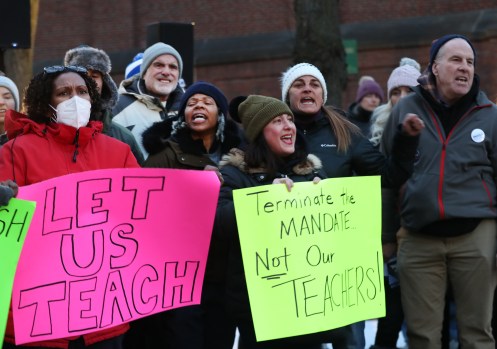
The lawmaker highlighted how, less than a month after he left the Air Force Reserve, his wife, Kerri, lost her job as a teacher in Rhode Island for not complying with the COVID-19 vaccine mandate after the school district denied her religious exemption request.
A year later, a Rhode Island Superior Court judge ruled in favor of Thurber’s wife and two other teachers also fired for refusing to take the vaccine, finding the district had violated an Open Meeting Act law over their issuance of the mandate.
The school committee reached a settlement with the teachers in 2023, issuing each of them $33,333 payments and back pay of over $50,000, according to Rhode Island news reports at the time.
Similar situations have played out in Massachusetts in the aftermath of the pandemic.
In one instance, an independent arbitrator ruled in August 2023 that the Massachusetts State Police did not have the right to claim it couldn’t accommodate the request of eight troopers who sought religious exemptions to the vaccine mandate because of “undue hardship.”
“Courts are determining that bodily autonomy and living a life free of coercion is a fundamental right,” Thurber told the Joint Committee on the Judiciary. “However, thousands of Massachusetts residents … who are forced to choose between their conscience and their careers are still living with the consequences of this injustice.”
The proposed bill pending on Beacon Hill carries limited exceptions for specific health-related interventions, including drug or alcohol testing, any medical testing required for any vehicular license, or admission to a general or psychiatric hospital for evaluation and treatment.
If someone’s rights under the bill are violated, they can seek damages and legal fees, the legislation outlines.
“This bill is not about whether or not to get vaccinated,” O’Connor, a South Shore Republican, said during the legislative hearing last week. “This is about whether or not an employer should have the ability to fire someone based on what is ultimately a personal medical decision.”
In a Democratic-controlled Legislature, the bill could be short-lived. The push comes as some lawmakers are again looking to eliminate religious exemptions for immunizations required in public, private and charter K-12 schools across the Bay State.
Under the proposals, schools must submit data annually to the state Department of Public Health about how many students are vaccinated and how many received a medical exemption, with that information then made publicly available.
The Massachusetts Chapter of the American Academy of Pediatrics is connecting its support of those bills to how it says the “COVID-19 pandemic and the recent measles outbreaks have revealed how devastating a disease outbreak can be in our communities.”
“Scientific evidence from the fights against polio, measles, and COVID-19 have demonstrated that vaccines are among the most effective and safest means to prevent individual illness and protect public health,” the chapter wrote in a letter to lawmakers.
Boston health officials announced late Friday that a traveler with a confirmed case of measles visited the city from June 7 – 8, making stops at the Westin Boston Seaport District Hotel, the Museum of Fine Arts and Logan Airport before flying on JetBlue Flight 639 to Miami.
In Suffolk County, 94% of children have been fully vaccinated against measles, according to DPH data.
Bay State families have grown resistant to vaccine mandates over the years.
The Massachusetts Family Institute highlighted in a summary of a legislative hearing held earlier this month that 59 of 70 people had testified in opposition to the bills that look to increase vaccination requirements and reporting standards.
Nationally, Health and Human Services Secretary Robert Kennedy Jr. dismissed all 17 members of the CDC’s Advisory Committee for Immunization Practices, with the move “necessary to reestablish public confidence in vaccine science.”
State DPH Commissioner Robbie Goldstein called the news “troubling.”
“It amends a science-based process that has informed vaccine recommendations and promoted vaccine access for decades,” he said. “The future of federal vaccine policy is unclear.”
Companies that didn’t mandate COVID-19 vaccines still proved to be tough on employees who decided against receiving the injection.
Saugus resident Anne Marie Cromwick, who didn’t get vaccinated, said the small pharmaceutical research company she worked for during the pandemic “implemented policies that essentially relegated me as a second-class citizen.”
Cromwick told the Joint Committee on Judiciary that the company restricted her to eating lunch at her desk and not in a cafeteria with her colleagues. If she attended a large gathering, she said she had to work from home for 10 days after the event.
“The role of the government is to provide the best information and guidance while allowing for robust debate,” Cromwick said, “and the idea that the science is settled is absurd.”
“What is most important in a free society is to protect the rights of citizens,” she added, “not to mandate a one-size-fits-all approach to public health.”
Herald wire services contributed to this report